Approve private-label tool packaging as one versioned set: product identity, labels, manual, included items, protective layout, barcode data and carton specification. Release printing and packing against that set after the artwork and a representative packed sample have been reviewed. Keep the approver and revision date with the approval.
This connects what the buyer orders, what the retail box promises and what receiving staff can check. Start with the selected model and contents from the RFQ brief, then use the checklist below to turn them into an approval file.
The packaging approval checklist
| Approval item | What the file should show |
|---|---|
| Model and brand | Buyer brand, exact model, product description, supplier-model mapping where needed, and an image of the ordered version. |
| Rating label | The selected electrical or engine ratings, traceability fields, approved markings and the label artwork version. |
| Manual | Destination languages, matching product diagrams, assembly and maintenance information, and the approved file revision. |
| Contents | Tool, batteries, charger and accessories as applicable, with quantities matching the quotation and contents list. |
| Inner protection | Positions and restraints for the actual contents, protected edges or cutting parts, and a packed-sample photo reference. |
| Barcode | Buyer-supplied identifier, readable text, intended location and a scan result checked against the approved data. |
| Carton data | Measured unit-package and master-carton dimensions, the contents basis for weight, units per carton and shipping marks. |
| Approval | Artwork and packing references, revision, approval date, named approver and any unresolved release condition. |
Use one row for each model and configuration. A shared brand layout can be reused, while the model text, ratings, pictured contents and document references stay specific to the version being supplied.
Freeze the model and contents before artwork
Make the approved contents list the source for the carton copy and product picture. A tool-only offer and a battery kit need their own unambiguous descriptions. For a kit, show the selected battery and charger identities and quantities; a photograph of several optional accessories is not a contents list.
Connect the buyer's retail SKU to the supplier's model reference in the approval file. The connection helps the artwork reviewer, inspector and warehouse use the same product identity. The model-specific spare-parts guide covers additional service stock, which should be itemized separately from the standard retail package.
Keep product claims tied to the actual specification and supporting record. The European Commission's importer and distributor guidance explains that own-name marketing can carry manufacturer responsibilities. An attractive carton or a familiar mark is not a substitute for the applicable product and document review.
Use the packed sample to complete the logistics fields
Measure the proposed package with its selected contents and record the units used. Distinguish a unit box from a master carton, and identify what is included in each weight. Have the shipping marks, packing list and approved carton data describe the same configuration.
A useful approval file includes the assembled product and contents list, the packed arrangement, the closed unit box, and the master-carton marking. These views answer different questions: what is supplied, how it is restrained, which retail offer it represents, and how the shipment can be identified.
A real packaging record: what usable evidence looks like
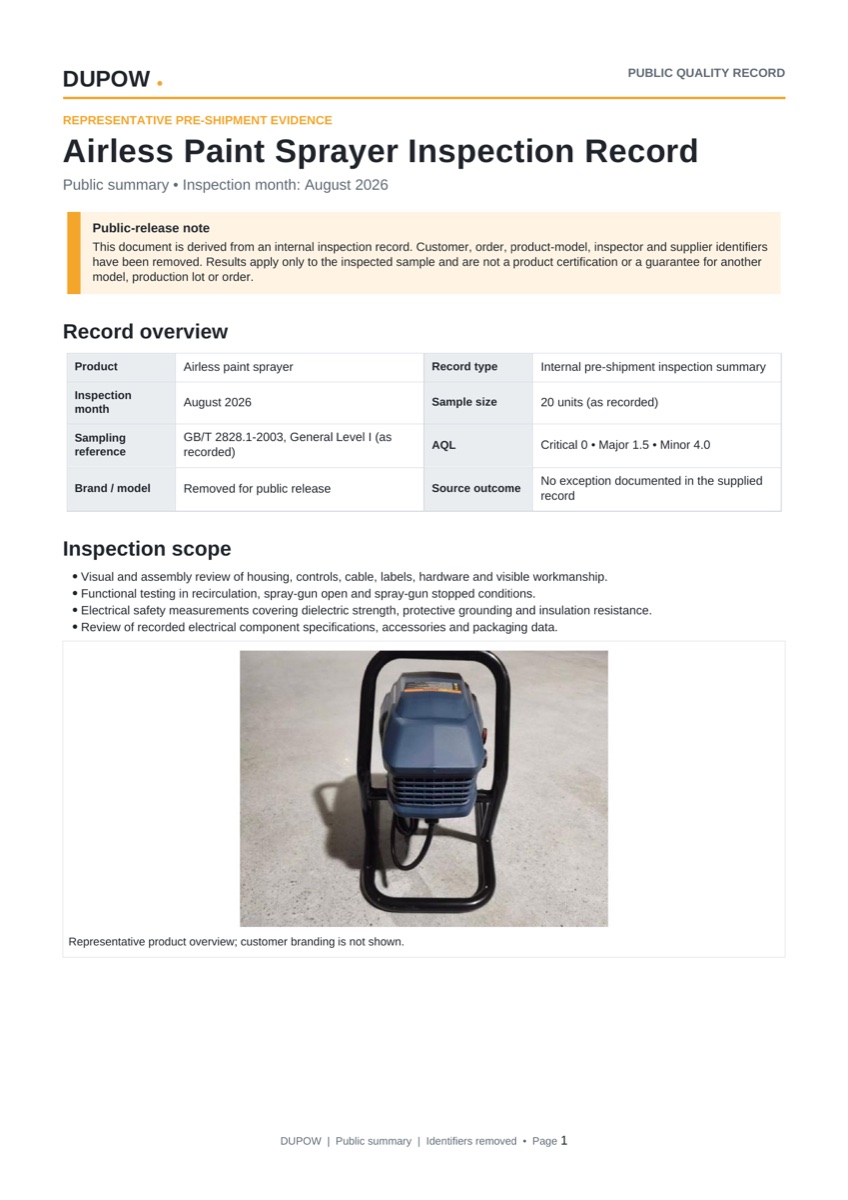
DUPOW's public airless sprayer pre-shipment review includes measured packaging information from an anonymized August 2026 record:
| Recorded field | Public record entry |
|---|---|
| Sample scope | 20 units recorded in the pre-shipment sample. |
| Unit package | 37 × 29 × 43.5 cm. |
| Net weight | 8.6 kg. |
| Gross weight | 9.9 kg. |
These entries apply to that inspected sample. The public record removes product-model and customer identifiers and does not contain a separately signed final acceptance. It illustrates the measurements to retain with an approval file; it does not supply carton data for a different tool or order.
Move from artwork to a controlled packing release
- Set the specification. Record the exact model, contents, languages, box format and required label information.
- Review the artwork. Check model names, ratings, product image, contents wording, barcode data and manual against the same specification.
- Review the packed sample. Confirm component positions, protection, measured carton data and the printed sample's barcode result.
- Record the release. Retain the approved files, sample or photo references, approver and date. Issue a new revision when an affected component changes.
The pre-shipment inspection checklist can then use those references for the shipment review. Artwork approval, observations on a sample and the final shipment-release decision remain identifiable records.
Correct common packaging mismatches before printing
- The box shows a battery kit, but the order is tool-only. Change the pictured contents and package description to the selected offer before approving artwork.
- One carton weight is reused after the accessory set changes. Re-measure the packed configuration and update the relevant carton and packing-list entries.
- A barcode looks correct on screen but identifies the wrong SKU when scanned. Compare the printed result with the approved identifier and the intended retail offer.
- The manual diagram or rating label comes from a nearby model. Replace it with the matching version and record the corrected file revision.
For a new program, send the model list, destination, branding files and packing request through DUPOW's OEM/private-label service. The commercial terms explain the planning basis for sample and packaging approval before production timing.
Buyer FAQs
Can several models use the same packaging design?
They can share a brand layout, but the model, ratings, images, contents and document references need the correct version for each offer. Keep the approved variations identifiable.
Is approving a barcode image enough?
Check the data as well as the appearance. Scan the printed sample and compare the result with the buyer-approved identifier and retail SKU before release.
Are extra spare parts part of the standard package?
The agreed contents list defines the standard package. List additional service stock separately, including its quantity basis and packing identity.
Which changes require the packaging file to be reviewed again?
Review the affected items when the model, electrical version, contents, language, claims or packing structure changes. Retain the previous approval and record the replacement revision.