A cordless circular saw range should make the intended job clear before a buyer compares prices. Blade diameter, cutting depth and blade mounting dimensions answer different questions. Putting them into separate fields helps an importer build an accurate range and gives a private-label team a useful starting point for samples, packaging and accessory orders.
This guide compares DUPOW's DUP-CS-004 and DUP-CS-005, then explains where the 20V DUP-CS-006 fits into a shortlist. It focuses on straight and bevel cutting requirements rather than treating the biggest blade or the highest no-load speed as a complete performance ranking.
Start with the section that must be cut
Describe the material, its thickness and the cut your customer needs. A distributor serving sheet-material users may organize its offer differently from one supplying timber-framing customers. Add the required finish and whether bevel cuts are part of normal work. This turns a broad request for a cordless saw into a specification your sample team can assess.
Keep the material name with the thickness. A statement about timber does not automatically describe cutting metal, masonry or every composite panel. The selected saw, blade and instructions must support the proposed task. For a wider assortment spanning several saw types, the existing portable saw range guide helps establish the category roles first.
Separate blade diameter from straight and bevel capacity
The blade diameter identifies the blade size; it is not the depth of material available below the saw's base. Cutting depth also needs an angle. Keep the maximum cut at 90° separate from the maximum cut at 45°, particularly when your customers use a saw for angled work.
Bosch Professional's circular-saw technical information separates blade diameter, bore diameter and cutting information. That is a useful way to organize a comparison; the DUPOW figures below come from the corresponding DUPOW models.
| Model | Blade and no-load speed | Maximum cutting depth |
|---|---|---|
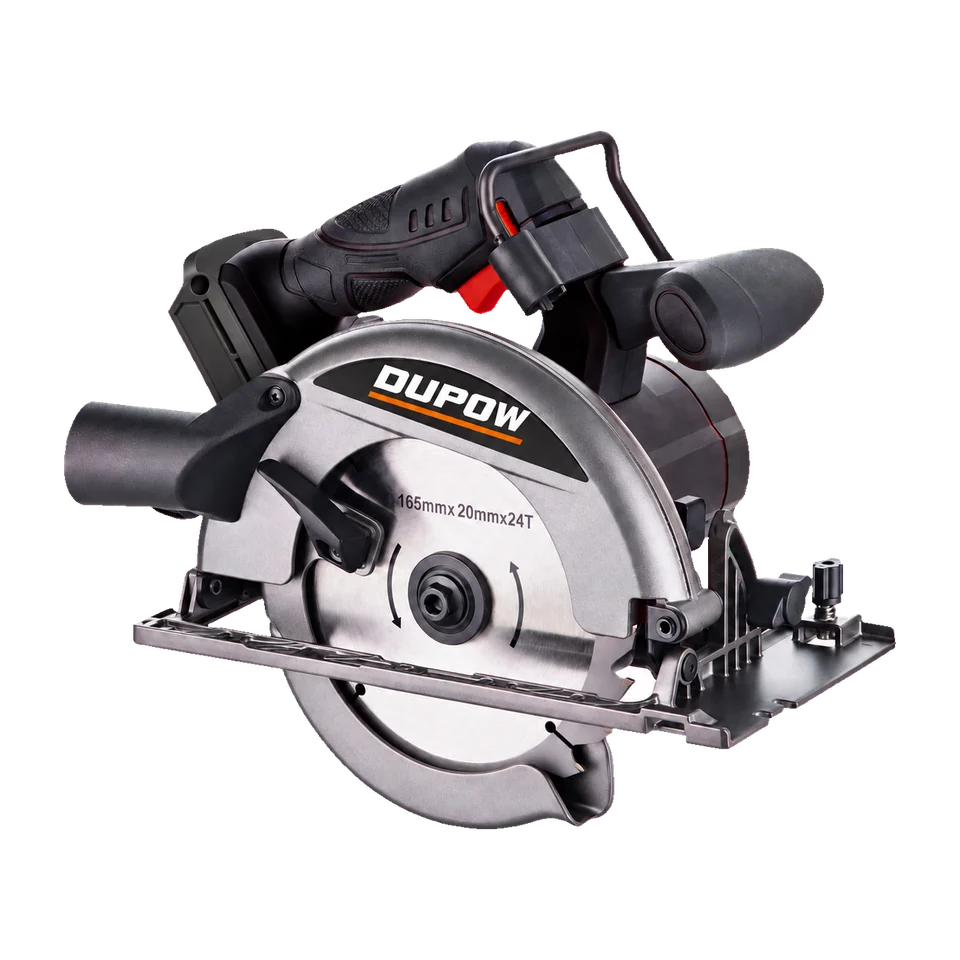
| DUP-CS-004 | 165 mm; 5,500 rpm | 55 mm at 90°; 36 mm at 45° |
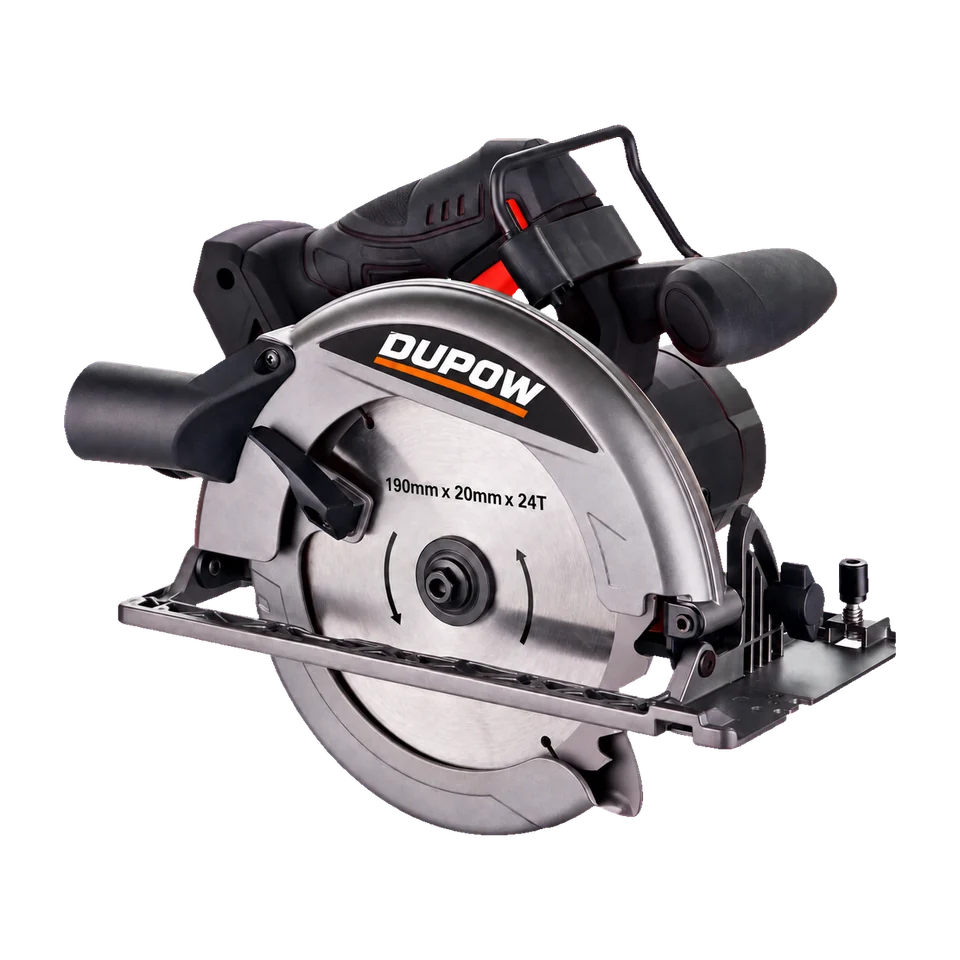
| DUP-CS-005 | 190 mm; 5,000 rpm | 65 mm at 90°; 44 mm at 45° |
CS004 and CS005 therefore provide two defined capacity positions. Choose between them using the sections and angles in the buying brief. A larger listed maximum depth may be relevant to a thicker workpiece, while the overall tool and selected battery still need to be assessed for the intended handling and work pattern.
Specify the complete blade identity
For CS004, the listed standard blade is 165 × 20 × 1.6 mm, 24T. For CS005, it is 190 × 20 × 1.6 mm, 24T. Keep the complete designation with the model rather than shortening both entries to a tooth count. Blade diameter and mounting dimensions matter when ordering replacement stock.
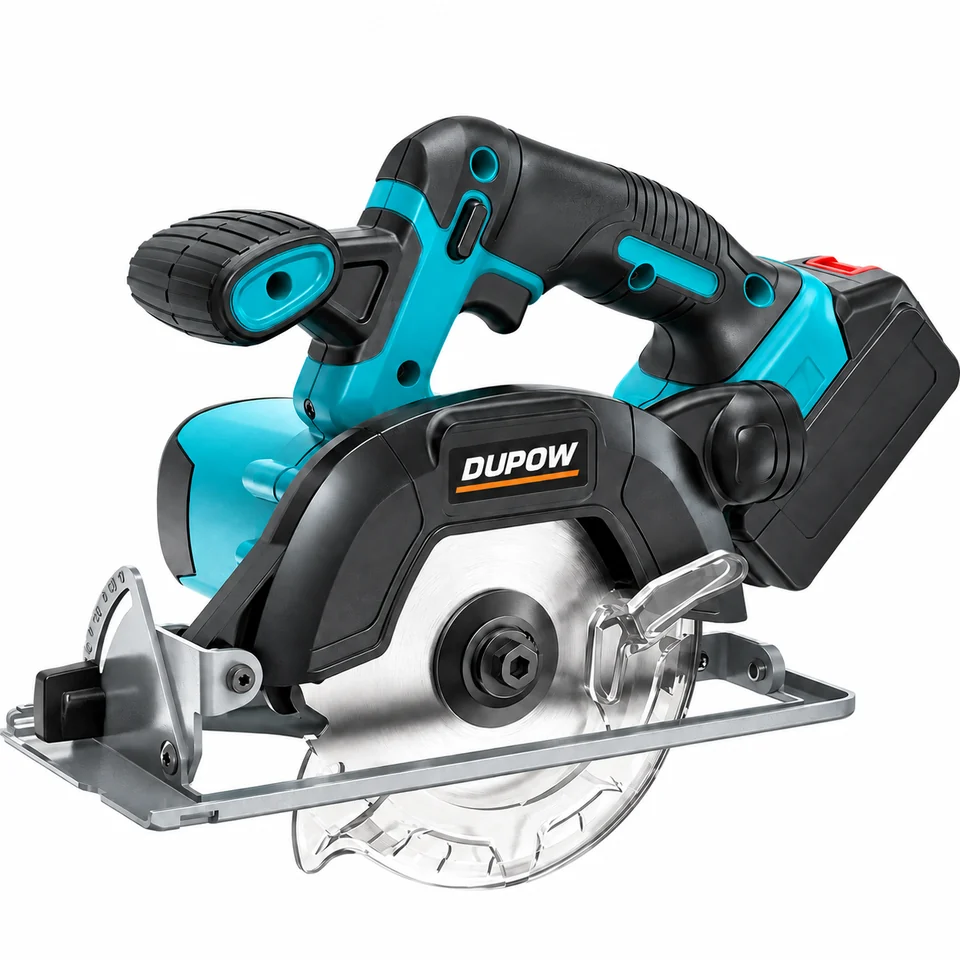
The separate DUP-CS-006 is a 20V model with a listed no-load speed of 3,600 rpm and a blade designation of 165 × 25.4 × 24T. It should have its own accessory record. Sharing a nominal 165 mm diameter with CS004 is insufficient to make the blades interchangeable, and CS004's cutting-depth figures should stay with CS004.
The Bosch circular-saw blade specification catalogue illustrates why accessory records distinguish diameter, bore, kerf, tooth count and permitted speed. Use those fields to request the matching blade for your DUPOW order. Select material-specific blades according to the saw and accessory instructions.
Assess the base, guides and handling together
CS004 and CS005 list aluminium upper guards, lower guards and bases, together with an electric brake and LED work light. Their standard accessory records include a hex key and parallel guide. These details give the sample team concrete items to inspect without assuming that a photographed accessory is included in every sales package.
Set out a short review sequence: identify the sample, compare it with the quotation, inspect the specified controls and accessories, and assess the agreed cutting task using the intended battery and blade. Record the material and setup beside the result. A useful commercial comparison describes what was actually reviewed rather than turning a no-load speed figure into a claim about cutting output.
For accessories such as an extraction adapter or guide rail, include the exact item in the request. A parallel guide and a guide-rail system are different arrangements. Show the supplied configuration clearly in the retail contents list.
Build one consistent tool or kit offer
CS004 and CS005 are listed within a 20V / 40V battery-platform family, while CS006 is listed as 20V DC. Identify the exact tool, battery and charger combination in the quotation. The family label alone does not specify the pack arrangement or establish interchangeability between products.
For a bare-tool order, name the saw and the included blade and accessories. For a kit, add the battery reference, capacity, quantity, charger version and packing. Use the 20V platform planning guide to organize a multi-category program, and browse the circular-saw category for the current model range.
Private-label and ecommerce teams should approve the model specification, package contents and product photographs together. Keep a separate retail SKU for each kit so the same saw does not acquire inconsistent accessory descriptions across listings. Consolidate branding, manual languages, quantities and destination-market requirements in the RFQ brief.
Buyer FAQs
Does a 190 mm blade mean a 190 mm cutting depth?
No. Blade diameter and cutting depth are separate specifications. CS005 lists a 190 mm blade and maximum depths of 65 mm at 90° and 44 mm at 45°.
Can CS004 and CS006 use the same blade because both are 165 mm?
Diameter alone is insufficient. Their listed blade designations differ: CS004 uses 165 × 20 × 1.6 mm, 24T, while CS006 lists 165 × 25.4 × 24T. Order the matching accessory for the exact model.
Which cutting-depth figure should a buyer put in a comparison?
Show the required material and angle. For CS004 and CS005, keep the 90° and 45° maximum depths in separate fields so bevel requirements remain visible.
What should a circular-saw quotation include?
Include the model, quantity, material and cutting requirements, matched blade and guide accessories, tool-only or kit configuration, destination, branding and packing. The itemized quotation defines the complete offer.
Request a cordless circular-saw shortlist with the material, thickness and order configuration you need.